
The Dey Uprising: Iran at a Volatile Interregnum
Publié le 24 février 2026
Citer cet article
APA
Etaati, S. (2026). The Dey Uprising: Iran at a Volatile Interregnum . Histoire Engagée. https://histoireengagee.ca/?p=13775Chicago
Etaati Saeedeh Niktab. "The Dey Uprising: Iran at a Volatile Interregnum ." Histoire Engagée, 2026. https://histoireengagee.ca/?p=13775. Fichier RIS
Fichier ENW
Fichier BibTeX
Saeedeh Niktab Etaati, curator at the Canadian Museum of History
— English will follow —
La semaine dernière, HistoireEngagée a publié un texte de Saeedeh Niktab Etaati, qui avait aimablement accepté notre invitation à livrer une analyse inscrivant, dans une perspective historique, les causes et les enjeux de la situation en cours en Iran.
Compte tenu de l’importance et de l’actualité du sujet, et afin de toucher un public plus large – en particulier au sein de la diaspora iranienne –, nous avons choisi d’offrir également, à titre exceptionnel, la version originale anglaise de cette contribution.
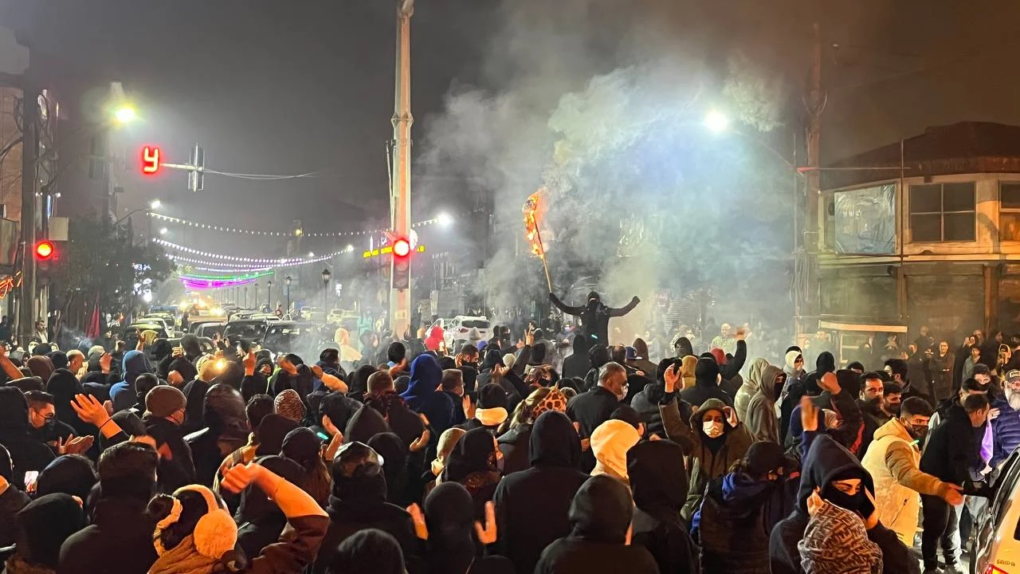
Crowd of protesters in Iran. Photo : @VahidOnline
Place: Bandar-e-Anzali, Gilan Province
Date: January 8, 2026 ( Dey 18, 1404 in the Persian Calender)
Since the last days of December 2025 — the month of Dey in the Persian calendar — Iranian streets have once again become the heroic, albeit tragic, stage of a nationwide uprising against the regime. This time, however, many Iranians believe the uprising may mark a turning point in the 47-year-old Islamic Republic
Sparked by the accelerating collapse of Iran’s currency, the rial, the initially economically driven unrest quickly evolved into a sociopolitical uprising targeting the entire regime. Chants of “Death to the Dictator” and “Death to Khamenei” (Iran’s supreme leader) resonated across all 31 provinces, even in peripheral regions far from the capital Tehran, such as Ilam, Lorestan, Khuzestan, and Kurdistan.
Youth, women, students, workers, shopkeepers, queer communities, ethnic minorities, and even children carried the Dey revolt into the third week of January, only to face one of the deadliest crackdowns by the regime’s repressive forces. Live ammunition and pellet guns were used to violently suppress unarmed protesters, particularly during the 15 days of a government-imposed nationwide digital blackout.
Scattered reports by human rights organizations, leaked footage circulated by activists and citizen journalists, and testimonies from healthcare workers point to a massacre on a national scale, executed in silence and deliberately concealed from the world. Thousands upon thousands were slaughtered in mass shootings in the streets, especially between January 8 and 9, with countless others wounded, detained, or forcibly disappeared[1]. Imprisoned protesters and former political prisoners face the imminent threat of mass execution on alleged charges of treason and espionage for the state’s so-called enemies, Israel and the United States. By early February, martial law and nightly curfews remained in force after 7 p.m. in certain cities, while Internet connectivity had yet to be fully restored in all areas.
While families of the victims and the disappeared continue desperately searching for the bodies and traces of their loved ones, from morgues to detention centres, the country now lives under the menacing shadow of potential U.S./Israel military intervention. “Help is on the way,” Trump promised protesters, as a U.S. naval fleet entered waters near the Middle East on January 30, 2026.[2] Meanwhile, the resurgence of a “return of the monarchy” ideology, placing faith in the exiled son of Iran’s former Shah to “Make Iran Great Again” (MIGA), has further fragmented Iranians both inside the country and across the diaspora, polarizing society into opposing camps of us and them.
While the nation is still mourning one of the deadliest chapters in its modern history, and amidst the varied factors and unforeseeable political actors in place, I attempt in this paper to address three critical questions: What led to this critical moment in Iran’s contemporary history? How is the current turbulent time shaping the historical thinking and political consciousness of Iranians inside and beyond the borders? And what new order do Iranians imagine might emerge from this interregnum? To answer the first question, I offer a brief genealogy of mass protests in the last two decades, situating the Dey uprising within Iran’s broader political landscape, and then reflect on how it has impacted both the formation and fragmentation of the diaspora. The latter two questions concerning the present and the future are more difficult to tackle, as events are currently unfolding at an unprecedented pace. However, even attempting to address them is essential, as they foreground Iranians’ lived experiences of history at the centre of interpreting the present and imagining future beyond abstract analysis.
The tradition of revolt
It is widely believed that the 1979 Revolution was a people’s revolution, born of a broad coalition of diverse and at times opposing political ideologies united against Pahlavi autocracy. Various political currents, including Islamists, the Left, Nationalists, and Liberals — together with social groups such as labour unions, students, bazaar merchants, and civil servants — formed an alliance that ultimately forced the Shah into exile. February 11, now commemorated as the Revolution Day, marks the overthrow of the Pahlavi regime. This political rupture triggered the first and one of the largest waves of immigration into exile, composed largely of loyal monarchists.
After the Shah’s fall and a subsequent popular referendum, religious Islamist forces under Ayatollah Khomeini’s leadership consolidated power and transitioned the political order into an Islamic theocracy with republican institutions, including presidency, parliament, and local councils. Drawing selectively on Shia Islamic theology and elements of revolutionary Marxist discourse, the newly established state articulated “Neither East, Nor West; Islamic Republic” as its guiding foreign policy doctrine, framing opposition to American imperialism as a central political tenet. Over time, however, this governance model evolved into a form of religious despotism, marked by the concentration of authority in the hands of an unelected and irremovable Supreme Leader. In practice, the regime’s anti-imperialist rhetoric gave way to pursuit of regional hegemony through the construction of a Shia geopolitical empire, sustained by proxy warfare and justified through claims of shared religious and ideological commitments with allied actors.
The first years following the revolution can best be characterized by the brutal and systemic repression of opposition groups, especially the Left, through mass execution, life imprisonment, and the imposition of gradual isolation and silencing. In this climate of intimidation and coercion, many remaining intellectual dissidents and their families were compelled to leave the country for Europe or North America.
The end of the first post-revolutionary decade (the late 1980s) marked a period of post-Iran-Iraq-War economic reconstruction, and a gradual social and cultural opening, beginning with Mohammad Khatami’s presidential election in 1997. The discourse of “reform” within the system resurfaced under his term, and student movements gained limited space to organize, express critical perspectives, and challenge dominant intellectual narratives. Women’s rights groups, NGOs, and civil associations likewise experienced relative empowerment within existing constraints. Ethnic minorities such as Kurds, Baluchis, and Arabs — long engaged in resistance against centralized power — continued their struggle for equality.
With this intellectual and political groundwork in place, the 2000s and subsequent decades witnessed numerous civil uprisings in Iran, demanding democratic reforms, women’s rights, justice for non-Persian ethnic minorities, and socio-economic equality. Below, I focus only on those movements most crucial for situating the current Dey uprising within the longstanding lineage of post-revolutionary revolt, intentionally leaving others aside due to the scope of this paper.
- The Green Movement (2009):
Led primarily by student organizations and young, middle-class Iranians, the mass protests that swept across Iran’s major cities in 2009 articulated peaceful dissent against the disputed presidential election results. Despite early poll predictions and widespread public support for reformist candidates Mir Hossein Mousavi and Mehdi Karroubi, hardliner Mahmoud Ahmadinejad, endorsed by the Supreme Leader, was declared the winner. Chanting “Where is my vote?”, protesters took to the streets, demanding that the government review and revise the election results.
One of the defining features of the Green Movement was the secularization and re-politicization of familiar Shia iconography to advance democratic demands. The colour green, traditionally associated with the holy figure of Imam Hussein, was reappropriated as the movement’s central symbol. The Demonstration of Silence on June 15, 2009, during which hundreds of thousands of protesters marched through the streets in silence with raised hands, powerfully embodied the movement’s commitment to peaceful resistance.[3] Even this quiet act of defiance was met with brutal state repression.
The protesters’ once-blooming collective dream of reform was soon shattered as the regime violently suppressed the movement and placed its key reformist leaders under house arrest, where they remain to this day. In the following years, many reformist thinkers and even politicians from within the system were imprisoned or forcibly marginalized.
The failure of the Green Movement became a key structural driver of intensified brain drain during Ahmadinejad’s presidency. Over the subsequent years, disillusioned young and educated dissidents gradually left Iran in pursuit of educational and professional opportunities abroad, as the discourse of reform from within the system steadily lost its credibility over time.
- The Bread Revolt (2017), Bloody Aban (2019), and the Uprising of The Thirsty (2021):
In 2017, a series of sporadic protests collectively known as the Bread Revolt, erupted in several peripheral provinces of Iran in response to soaring food prices, rising poverty, and the precarious conditions faced by the working class. These protests later escalated into a broader, nationwide movement in November 2019, the month of Aban in the Persian calendar.
Known as Bloody Aban, the movement was initially triggered by an overnight fuel price hike. However, like the current Dey uprising, economic grievances quickly shifted to explicit anti-regime demands. Slogans such as “Death to the Dictator” and “Death to Khamenei”— which later became emblematic of the Dey uprising — first emerged widely during Bloody Aban. The state responded with violent repression, deploying military and security forces who used live ammunition to crack down on protesters. Over a thousand were killed and many more detained. An Internet blackout, a new tactic of state repression, was imposed to carry out the massacre in darkness and media silence. Despite the unrestrained use of lethal violence, the mourning mothers of youths killed in the protests mobilized to form the resistance group Aban’s Mothers, which has maintained an active presence in subsequent movements.
Less than two years after Bloody Aban, the Uprising of the Thirsty ignited in Iran’s southwestern province of Khuzestan, home to a majority Arab-Iranian population. Despite containing the country’s largest oil reserves, Khuzestan has long faced systemic economic deprivation, political marginalization, infrastructural neglect, and environmental degradation. Bordering Iraq, many of its cities were battlegrounds during the eight-year Iran-Iraq War in the 1980s.
Water scarcity was the immediate catalyst for dissent. Yet, as the uprising unfolded, it revealed deeper environmental injustices and broader social grievances faced by the Arab minority. Although the Uprising of the Thirstydid not gain nationwide momentum, it is crucial to understand it in relation to other Iranian uprisings led by women. The voice of an Arab-Iranian woman, standing unarmed before a security guard asking why he was firing and inviting him to witness the peaceful protest, became an iconic symbol of courage and women’s resistance.[4] Her powerful voice later resonated throughout the Woman, Life, Freedom movement.
- Woman, Life, Freedom (2022):
Initiated by Kurdish women, the killing of 22-year-old Jina Mahsa Amini by Morality Police sparked a nationwide movement across Iran in September 2022. With women at the forefront, the protestors voiced both civil and political demands; they challenged the state’s gender-based violence and the denial of women’s rights including bodily autonomy, freedom of sexual and gender expression, and the imposition of male-preferential Islamic jurisprudence that regulates both public and private spheres. Their concerns extended beyond structural injustices; the uprising also confronted patriarchal society from within, creating space to question entrenched gender norms and gendered power relations governing the domestic sphere.
The well-known Kurdish slogan “Jin, Jiyan, Azadi,” long associated with feminist resistance movements in Rojava, was adopted by Iranians as the movement’s foundational tenets, guiding political and societal discourses toward gender justice and equality. As with previous uprisings, the protests faced a lethal crackdown: Thousands of young Iranian women and men were killed, many arrested, and some executed.
The current Dey uprising emerges from this long history of resistance. This popular movement is driven by two interlinked forces: class antagonism and revolutionary demands. Although it began in Tehran’s Bazaar, the uprising quickly mobilized the working class against the ruling elite, challenging unequal access to resources, systemic economic exploitation, and corruption by oligarchies, while above all demanding an end to the dictatorship.
The geography of the revolt is also noteworthy. As mentioned in the introduction, the movement spread across all provinces, with significant participation in Khuzestan, Ilam and Kurdistan. Like Jina’s uprising — and in contrast to the Green Movement — the peripheral regions inhabited by non-Persian ethnic minorities became epicentres of resistance. Their demands for self-determination and cultural autonomy aligned closely with the anti-establishment movement.
What makes this wave of uprising different from others is the unprecedented scale and intensity of state violence unleashed against the population. While precise figures for those killed, wounded and detained remain inaccessible due to the regime’s suppression of information, independent human rights organization Hengaw reports an exceptionally high death toll within a short timeframe, with numbers continuing to rise.[5] Amnesty International documents deliberate killings, including gunfire targeting vital organs and armed assaults on hospitals and medical personnel.[6] Verified videos and images[7] showing trucks hauling bodies wrapped in black tarps to morgues have scarred Iranian collective memory. Authorities sought to legitimize the brutal crackdown as a response to a “hostile plot by the enemies,” recycling their well-worn foreign conspiracy narrative that frames the Dey uprising as a continuation of the 12-day war between Iran and Israel in June 2025, allegedly orchestrated by Mossad, the U.S., and local “rioters.” Yet such manufactured claims only further fueled popular outrage and deepened public repulsion toward the regime.
Reactionary forces in play
At present, there are no definitive answers regarding what Iranians inside the country think about the unfolding events, or how they envision their future. Persian-language propaganda outlets and Farsi social media platforms selectively amplify narratives that distort the political pluralism that exists both inside Iran and across the diaspora. Nevertheless, the limited ethnographic accounts collected by activists[8] and journalists[9] inside the country consistently indicate that, despite ideological differences among protesters, they are united in rejecting the current state. In the eyes of a majority, the Islamic Republic has lost its political legitimacy.
There are also indications in Tehran and other major cities of seemingly growing, though uneven, support for the return of Reza Pahlavi, the self-proclaimed Leader of the Opposition. The eldest son of the deposed Shah has lived in the U.S. since the 1979 revolution and has cultivated close ties with Israel. During the Woman, Life, Freedom movement in 2022, he positioned himself as a central figure of the monarchist opposition and joined other opposition actors in a coalition that never materialized. His promise to protesters this time is a transitional government under his leadership as a pathway toward a democratic future. However, the Emergency Phase[10] plan he released in 2024 as a roadmap to a “free Iran” does not align with democratic ideals and instead appears modelled on a reproduction of authoritarian governance.
Iranians in the diaspora are also fragmented in how they imagine themselves as a community and politically align in envisioning an alternative for Iran. As a dynamic society, like other diasporas, they are engaged in constant negotiations over meaning, rather than being rooted in a static past or a singular collective imagination.[11] One faction, composed of those who left following the revolution and settled primarily in Los Angeles, Toronto, and Vancouver in the 1980s, adheres to conservative monarchism. At its extreme, this group embraces ethno-nationalist values coupled with Persian supremacy, and amid the global resurgence of fascism, has increasingly gravitated toward far-right movements. Adopting MAGA-style rhetoric and subculture, they promote a fantasy of “Make Iran Great Again” through any perceived saviour, including alignment with the genocidal Israeli regime.
In the middle lies a sizable group that I classify as instrumental or pragmatic monarchists. While not necessarily sharing the ideological commitments of hardline right-wing monarchists, they nonetheless view Pahlavi as the only viable exit from the Islamic Republic. A similar logic appears to animate some of his supporters inside Iran. Historical amnesia, nostalgic glorification of the Pahlavi era, and political as well as moral appeasement, conspire to persuade many to entrust the son of a former dictator to lead the way toward liberation and democracy. That a nation with a long history of resistance to authoritarian rule would even entertain such a possibility — despite having overthrown the monarchy nearly half a century ago — speaks less to conviction than to political despair and the profound leadership vacuum produced by the regime’s systematic repression of alternative opposition currents.
A third group within the diaspora, whose voices are less amplified and whose presence is far less visible, consists of the remaining Left. While internally diverse in their political histories and positions, they explicitly distance themselves from the so-called “Axis of Resistance Left,” a current that routinely ignores the totalitarian foundations of the Islamic Republic and persistently sanitizes its atrocities under the guise of hollow anti-imperialist rhetoric.
This strand of the Left is grounded in a deep understanding of intersecting systems of oppression. While firmly opposed to domestic domination and state violence, they also articulate a nuanced critique of imperialism; one that stands in contrast to the reductive positions adopted by Western campist leftists. For them, the regime’s regional militarism and performative support for Palestine do not constitute genuine anti-imperialism. Rather, these actions expose a project of reordered regional dominance, built through proxy warfare and militia networks.
From this perspective, the state’s loss of legitimacy and the collapse of Iran’s economy cannot be reduced solely to the effects of U.S.-imposed sanctions. Instead, these phenomena are understood as symptoms of a deeply corrupt oligarchic ruling class that has governed through repression, coercion and mismanagement. They navigate contradictions that some non-Iranian leftists cannot ideologically resolve: They are strongly anti-genocide, simultaneously opposed to the repressive Islamic Republic, and uncompromisingly critical of U.S. imperialism. Central to their understanding of Iran’s complex situation is the humanization of protesters and recognition of their agency. In this view, tens of thousands of lives lost in the Dey uprising cannot be flattened into abstract analysis or subordinated to geopolitical alignment.
Numbered days
“The old world is dying, and the new world struggles to be born; now is the time of monsters.”[12]
Antonio Gramsci (1891–1937), the Marxist thinker and political theorist, wrote these words in prison to describe the condition of an interregnum: A crisis of authority in which the ruling class has lost legitimacy and can rule only through coercion, while an emerging order has not yet consolidated power. Such moments, Gramsci warned, create fertile ground for political monsters, such as authoritarianism, extremism, and reaction.[13]
Iran after the Dey uprising inhabits precisely Gramsci’s disordered interregnum. The nation is becoming ever more outraged and grief-stricken, while the state continues to rule through coercion rather than consent. The reactionary movement of Pahlavi monarchism has re-emerged, whereas progressive forces — imprisoned, silenced or exiled — appear sidelined from political competition. Meanwhile, U.S. imperial militarism, cloaked in the deceptive promise of humanitarian liberation, once again threatens the country with destruction. For ordinary Iranians, any sense of normalcy or future has been replaced by melancholy, fear, and fragile hope.
This morning, I asked my mother, who lives in Iran, what she thought would happen next. “Their days are numbered,” she said. “When the Shah was about to be overthrown, he killed many of us. They are now doing the same.”
“And who will come after, if not another dictator?” I asked.
“Iranians will return to the streets,” she replied, “until Iran is free.”
Bibliography
Amnesty International Canada. Iran: Massacre of Protesters Demands Global Diplomatic Action to Signal an End to Impunity. January 14, 2026. https://amnesty.ca/human-rights-news/iran-massacre-protesters-demands-global-action-end-impunity/
Ali, Idrees, and Phil Stewart. “U.S. Sends Additional Warship to Middle East amid Iran Tensions.” Reuters, January 29, 2026. https://www.reuters.com/world/middle-east/us-sends-additional-warship-middle-east-amid-iran-tensions-2026-01-29/
Author Unknown. « جز جستجوی آزادی راه دیگری نمیشناسیم ــ نامهای از تهران » [“We Know No Way Other Than the Search for Freedom: A Letter from Tehran” in Farsi]. Asoo, January 20, 2026. https://www.aasoo.org/fa/articles/5274
Feminists4Jina. “Longing for Liberation, Trapped Between Two Reactionary Forces.” Report from December–January 2025, Tehran. Feminists4Jina. Accessed February 5, 2026. https://feminists4jina.net/archives/1909
Gramsci, Antonio. Selections from the Prison Notebooks. Edited and translated by Quintin Hoare and Geoffrey Nowell Smith. London: Lawrence & Wishart, 1971.
Hall, Stuart. “Cultural Identity and Diaspora.” In Identity: Community, Culture, Difference, edited by Jonathan Rutherford, 227–37. London: Lawrence & Wishart, 1990.
Hengaw Organization for Human Rights. Hengaw Special Report Finds Iran’s December Protest Crackdown Amounts to Crimes Against Humanity. January 24, 2026. https://hengaw.net/en/reports-and-statistics-1/2026/01/article-6
Human Rights Watch. “Iran: Growing Evidence of Countrywide Massacres.” January 16, 2026. https://www.hrw.org/news/2026/01/16/iran-growing-evidence-of-countrywide-massacres
Jomana Karadsheh et al. “Iran’s Internet Blackout and Violent Crackdown on Protesters.” CNN, January 23, 2026. https://www.cnn.com/2026/01/23/middleeast/iran-internet-blackout-violent-crackdown-intl-cmd
Mintz, Steven. “The Old World Is Dying and the New One Is Struggling to Be Born.” Inside Higher Ed, March 17, 2025.
National Union for Democracy in Iran (NUFDI). مرحله اضطراری [Emergency Phase in Farsi] (EmergPhase_v3_PERS) [in Farsi]. Munich: NUFDI, July 2025. PDF, 168 pp. https://fund.nufdiran.org/wp-content/uploads/2025/07/EmergPhase_v3_PERS.pdf
مظاهرات سلميه [Peaceful Protest; in Arabized Farsi]. YouTube video, 3:21. Uploaded January 12, 2026. https://www.youtube.com/watch?v=gS5hthisZXs
تظاهرات سکوت جنبش سبز، میدان 7 تیر تا انقلاب، 27 خرداد 88 [Green Movement Silence Demonstration, 7 Tir to Enghelab Square, 27 Khordad 1388]. YouTube video, 5:42. Uploaded by Green Protestor, June 16, 2009. https://www.youtube.com/watch?v=wy6D99MBCM4
[1] Jomana Karadsheh and others, “Iran’s Internet Blackout and Violent Crackdown on Protesters,” CNN, January 23, 2026, https://www.cnn.com/2026/01/23/middleeast/iran-internet-blackout-violent-crackdown-intl-cmd
[2] Idrees Ali and Phil Stewart, “U.S. Sends Additional Warship to Middle East amid Iran Tensions,” Reuters, January 29, 2026, https://www.reuters.com/world/middle-east/us-sends-additional-warship-middle-east-amid-iran-tensions-2026-01-29/.
[3] تظاهرات سکوت جنبش سبز، میدان 7 تیر تا انقلاب، 27 خرداد 88 [Green Movement Silence Demonstration, 7 Tir to Enghelab Square, 27 Khordad 1388], YouTube video, 5:42, uploaded by Green Protestor, June 16, 2009, https://www.youtube.com/watch?v=wy6D99MBCM4.
[4] The video is in Arabic-infused Farsi,
مظاهرات سلميه [Peaceful Protest; in Arabized Farsi], YouTube video, 3:21, uploaded January 12, 2026, https://www.youtube.com/watch?v=gS5hthisZXs.
[5] Hengaw Organization for Human Rights, Hengaw Special Report Finds Iran’s December Protest Crackdown Amounts to Crimes Against Humanity, January 24, 2026, Hengaw Organization for Human Rights, https://hengaw.net/en/reports-and-statistics-1/2026/01/article-6.
[6] Amnesty International Canada, Iran: Massacre of Protesters Demands Global Diplomatic Action to Signal an End to Impunity, January 14, 2026, Amnesty International Canada, https://amnesty.ca/human-rights-news/iran-massacre-protesters-demands-global-action-end-impunity/.
[8] Feminists4Jina, “Longing for Liberation, Trapped Between Two Reactionary Forces” (report from December–January 2025, Tehran), Feminists4Jina, accessed February 5, 2026, https://feminists4jina.net/archives/1909
[9] Author Unknown, « جز جستجوی آزادی راه دیگری نمیشناسیم ــ نامهای از تهران » [“We Know No Way Other Than the Search for Freedom: A Letter from Tehran” in Farsi], Asoo, January 20, 2026, https://www.aasoo.org/fa/articles/5274
[10] National Union for Democracy in Iran (NUFDI), مرحله اضطراری [Emergency in Farsi](EmergPhase_v3_PERS) [in Farsi] (Munich: NUFDI, July 2025), PDF, 168 pp., https://fund.nufdiran.org/wp-content/uploads/2025/07/EmergPhase_v3_PERS.pdf.
[11] Stuart Hall, “Cultural Identity and Diaspora,” in Identity: Community, Culture, Difference, ed. Jonathan Rutherford (London: Lawrence & Wishart, 1990), 227–37.
[12] Steven Mintz, “The Old World Is Dying and the New One Is Struggling to Be Born,” Inside Higher Ed, March 17, 2025.
[13] Antonio Gramsci, Selections from the Prison Notebooks, ed. and trans. Quintin Hoare and Geoffrey Nowell‑Smith (London: Lawrence & Wishart, 1971), 275–76.
Articles sur les mêmes sujets